

Dear Colleagues,
Welcome to the Summer 2023 newsletter.
I hope you are enjoying the lead in to the end of the year!
In this edition we have information abut our mentoring program that we hope many of you will participate in. There’s also details about the 2024 MII conference in Canada. You get to meet another of our members and there’s a little light reading in the form of two articles.
Our 2024 course schedule is being finalised, as are the details of the 2024 Education Weekend. Stay up to date on the details via our website.
Finally, don’t forget you can always refresh your skills and attain MDT CPD points by completing modules in the Case Manager.
On behalf of MIA, I wish you and safe and happy end to the year.
Take care.

Mark Cheel
Chairperson / Faculty
The McKenzie Institute Australia (MIA) is keen to establish a mentoring program for Part A participants to assist them with their McKenzie MDT journey, to encourage them to complete Parts A-D and the Credentialing exam.
Credentialed members recently received a questionnaire regarding expression of interest for the mentoring program. Thank you to those who have already responded.
Responses thus far indicate a preference for:
The MIA Board will support members who agree to be mentors by hosting an online information session, at the start of the program, to outline MIA's expectations and to assist with any questions or concerns.
Mentoring has many benefits for both the mentor and the mentee. It can challenge your own clinical reasoning, test your existing knowledge, develop or consolidate teaching/coaching skills and it can be rewarding to see growth in less experienced MDT clinicians. Mentoring also attracts MDT CPD points. The mentee of course gets the benefit of your knowledge and experience in a supportive environment.
Remember it's not too late to register your interest!!
Please contact education@mckenzieinstituteaustralia.org if you would like to assist us in establishing the program.
Sara Reed
Deputy Chair & Honorary Secretary
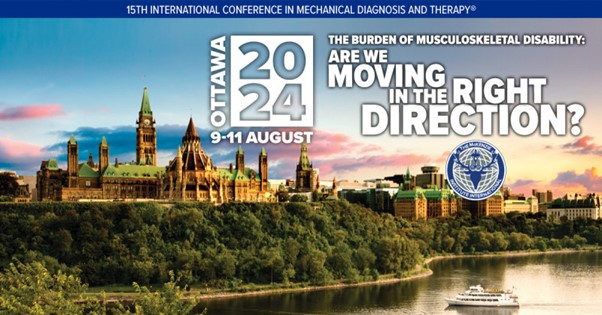
The 15th International Conference in MDT will be held in Ottawa, Canada in August 2024. Full details including conference programme, registration, travel and accommodation information available on the MII website: https://mckenzieinstitute.org/ottawa-2024/
Save $$$. Early bird discount available until 31 January 2024.

Tells us about your current work
I work 4 days per week for University of Sydney as a Physiotherapy Clinical Educator with University Centre for Rural Health in Lismore. My focus is facilitating exceptional clinical placement and education experiences for students in rural settings. I am a partner in Chapman Grove Physiotherapy where we utilise MDT almost exclusively. Being in a rural area, the MIA Clinician finder has connected us with clients from as far south as Port Macquarie and west to Dubbo.
How did you start on your ‘McKenzie Method of Mechanical Diagnosis & Therapy (MDT)’ journey?
My MDT journey started in the late 90's while working in USA. A colleague suggested we go to Atlanta for a big weekend and do a Part A to get our CPD requirements for the year in one sitting. I was totally mesmerised by MII faculty Mark Miller in his presentation of Part A. The rest is history. My journey continues as I enjoy attending and revisiting Part A through E courses as a refresher. I'll probably get around to becoming a Diplomat in the next few years.
How has the McKenzie Method influenced your clinical practice?
The McKenzie Method has enabled me to be the most effective clinician I could possibly be. The satisfaction that is derived from being able to help clients learn how to help themselves, always feels amazing.
Knowing what you know now, what piece of advice would you give your younger self?
Avoid running enthusiastically in the wrong direction!
When you're not working, what do you like to do?
I live on a farm, so there is always work to do. I do manage some downtime and I have a few hobbies; playing with old cars, being outdoors, camping and travelling. Listening to 90's Electronica and reading fiction.
Where do you see yourself in five years?
I will be working in the private practice, hopefully employing and mentoring some younger clinicians through their MDT journey.
If you weren't working in healthcare, what do you think you would have done?
I think I would have continued working in the fitness industry.
What's your favourite quote and why?
"Fear will pass. Regret is forever."
You’ve probably heard the phrase “actions speak louder than words”. As you consider the following articles, what relevance, if any, does such a statement have to clinical practice? Are actions and words separable or are they inextricably linked in every interaction with patients?
For full text access to these articles and more, don’t forget you can purchase a significantly discounted subscription to JMMT, via your MIA membership.
Happy reading!
Peter Schoch, Faculty
.png) Abstract
AbstractThe influence of directional preference on lateral patellar dislocation: a case report
Patella dislocation is most common in teens and young adults. Whilst initial management needs to consider the consequences of the (often) traumatic onset, what about months down the track if the patient still reports pain, instability and loss of function? Whilst many clinicians focus on ‘strengthening’, is that always the most important variable? As this case study demonstrates, identifying directional preference can help guide rehab strategies and contribute to rapid and lasting improvements in patient outcomes. With that in mind, why do you think the patient in this case study improved so quickly, after directional preference was identified?
Click here to read the full article (MIA members only)
 Abstract
Negative language use of the physiotherapist in low back pain education impacts anxiety and illness beliefs: A randomized controlled trial in healthy respondents
Research increasingly shows that patient outcomes may be influenced as much by what we say, as what we ‘do’ with our patients. What we say may be perceived differently by our patients and may, at times contribute to some unintended consequences. Do you ever reflect on how you talk with patients? How has your communication style evolved over time?
Click here to read the full article (MIA members only)
All attendees welcome, feel supported using MDT in your clinical practice.
|
When: Wednesday 21 February 2024 |
|
When: Wednesday 26 June 2024 |
|
When: Wednesday 4 September 2024 |
|
MDT End of Year Social |
Monitor the MIA website's Calendar of Events and follow us on social media for details of further courses, as they are released.
 |
Part A - The Lumbar Spine |
|
Part A - The Lumbar Spine |
 |
Part B - The Cervical & Thoracic Spine |
|
Part B - The Cervical & Thoracic Spine |
 |
Part C - Advanced Lumbar Spine & Extremities - Lower Limb |
 |
Part D - Advanced Cervical and Thoracic Spine & Extremities - Upper Limb |
 |
McKenzie Institute International - Credentialing Exam |
 |
 |
 |
Do you have something you’d like to share with other MDT trained clinicians? If so, please get in touch! Submissions to the newsletter are always welcome and contributions contribute to MDT CPD points for members. Tell us about an interesting clinical experience you’ve had, an article you’ve read or a case study that challenged you. Submissions can be emailed to: education@mckenzieinstituteaustralia.org