

Dear Colleagues,
Welcome to the Summer 2024 newsletter.
In this edition we have more information about our mentoring program, we share a case study on ear pain, and details about purchasing recordings from the recent MII conference held in Canada the link can be found here.
For 2025, MIA Education Update will be held Saturday 10th May 2025.
Jane Borgehammar and Melissa Kolski from the USA will be conducting ‘MDT and Chronic Pain’ masterclass, involving a one day ONLINE teaching, with pre course learning.
To register for this or any of our 2025 courses, check out our website. Please note that some courses are still being finalised. A reminder that MIA members can get a 50% discount on all Part A-D courses.
Finally, don’t forget you can always refresh your skills and attain MDT CPD points by completing modules in the Case Manager here
I wish you all a safe and happy end to the year.
Mark Cheel
MIA Chariperson

Thank you for your support of the Australian branch!
Your membership and ongoing participation is vital to help us continue providing high quality education; and in doing so to grow and maintain a community of practice of clinicians invested in the best care and outcomes for their patients.
All members receive significant discounts on our courses and education materials, including:
Full members also receive:
Help us continue our work by renewing your membership today.

Thanks to Credentialed member Andrew Noye from Geelong for this very interesting case study about a patient referred from an ENT surgeon. The patient responded remarkably well to an MDT assessment and treatment program, after medical management had not been able to help her improve her symptoms.
Another great example, on the back of the EXPOSS study (Rosedale et al 2020), of why screening the spine and being prepared to test force progressions and alternatives, can often yield quite dramatic results.
Background
43yo female nurse educator with constant right ear pain.
Pain started several days after swimming in a river with head submerged. Surmised to be potential ear infection. Tried Paracetamol and over the counter NSAID’s with no effect.
1st GP visit:
Reported to have bulging ear drum, thought to be inflammatory.
Prescribed 3 days of oral prednisolone and then review with GP in 1-week.
Also prescribed endone prn for analgesia.
2nd GP visit:
No change in symptoms, other than endone useful in temporarily reducing pain.
No change to eardrum on examination.
Prescribed oral anti-biotics as well as steroid-based eardrops.
GP review in 1-week.
3rd GP visit:
No change in pain, however starting to notice mildy reduced hearing R) ear.
On examination, ear drum appeared to look better.
Watch and wait, advised hearing test in one week if no better.
4th GP visit:
No change in symptoms.
Examination revealed pus in ear.
Referred to ENT surgeon for opinion.
ENT consult (two weeks after last gp visit):
“That’s not pus, that’s the eardrops”
Eardrops suctioned from ear. Hearing immediately improved.
No sign of any infection or inflammation or eardrum bulging.
Thought to be TMJ related.
Patient was asked: “Do you know a physio? Get them to check your TMJ”.
Physiotherapy initial assessment
Patient presented to physio one day after seeing ENT.
Described constant right ear pain for 8-10 weeks since swimming in river and submerging head. Physio was confident that between gp and ENT, specific ear-based pathology had been appropriately screened.
No symptoms in scapula or upper limb. No other pain or symptoms at present.
History of intermittent neck pain over 10 years. Previously tried manual therapy / heat with good effect. No specific ongoing self-management strategies.
No other red flags .
Worked part time as nurse educator – up to four days per week. Sitting computer work up to 70% of time. Walking around / standing up to 30% of time.
Normally walks dog daily for 45 minutes for general fitness. Netball 1 x week (game, no training).
Worse: being upright (standing, sitting, walking).
Better: lying down any position, endone
24/24: no waking at night. No change in am
Patient expectations – check my TMJ as per ENT doctor. Relieve the pain
Following further discussion about possible links between TMJ and ear pain and cervical spine and ear pain, patient agreed to screening of the cervical spine, in addition to the TMJ.
Physical examination.
Pre-test pain: 4/10 pain R) ear (described as “inside the ear”)
Movement loss
Cx spine: minor loss of retraction, extension, right rotation. Others nil loss.
TMJ: nil movement loss
Repeated movements
Cx spine:
Provisional classification: Cervical derangement syndrome, asymmetrical above elbow.
Directional preference: extension
HEP: Sitting retraction x 10-20 followed by retraction + extension x5-10, at least 3/day
Session 2 (24 hours later)
Overall better
R) ear pain now intermittent.
Still worse with prolonged sitting.
HEP being done regularly, reported to decrease / abolish symptoms each time it was done but symptoms returned / worsened with prolonged sitting.
Physical examination
Presenting pain: 2-3/10 right ear
Movement loss similar to session 1
Repeated movements
HEP: continue retraction + extension sitting or prone as able during day. Regular change of position out of sitting.
Session 3 (one week later)
Better++
Intermittent pain first couple of days after last physio session only with prolonged sitting.
Walking and standing not bringing on symptoms.
Was able to easily abolish with exercises either in sitting or prone
48 hrs ago whilst doing retraction + extension in prone felt a ‘pop’ in neck and been pain free ever since, including sitting!
Playing netball – no pain
Walking dog daily - no pain
Physical examination
Presenting pain – no pain
Movement loss – nil
Repeated movements – no effect
Patient was advised to continue regular cervical retraction + extension in sitting or prone to maintain range of motion. Also advised to get up and move regularly when sitting. Get in touch with physio if symptoms returned and she couldn’t self-manage them.
Final classification: Cervical Derangement Syndrome.
Directional preference extension
Reflections:
Important to screen for red flags given the history and onset – ruling out infection or some other systemic cause before starting physio helps ensure patient safety.
Listening to the patient, especially in the worse better section, to see if there may be clues about possible mechanical behaviour of symptoms, in response to loading / time in different positions.
As the EXPOSS study demonstrated, a proportion of patients with extremity symptoms, may respond to spinal focussed assessment and treatment. In this case the ear symptoms could be considered ‘extremity’, so screening the cervical spine, prior to focussing on TMJ, is not an unreasonable thing to do.
No movement loss in the TMJ, whilst there was movement loss in the cervical spine, on the same side as the symptoms, could be another indicator to thoroughly screen the spine.
Listen to the patient to get clues about possible testing positions / strategies (e.g. worse upright and better lying): could have cued me to start repeated movement testing in lying – supine or prone – earlier in the process. However, as she worked in job that involved sitting, it was reasonable to test her in sitting. If a green light response was achieved, she would be more easily able to incorporate reductive exercises into her everyday sitting activity; than having to find time and space to lie down.
Ensure getting end range retraction and extension to fully reduce the derangement.
What was the ‘pop’ that occurred during retraction extension in prone? Why was she pain free after that? Honest answer…. Don’t know! Interesting to hypothesize what it may have been but in reality, probably doesn’t matter in terms of achieving the desired outcome.
Can the cervical spine refer to the ear and potentially mimic other problems (infection / inflammatory) that may cause constant symptoms? From the response of this patient: Absolutely yes!
Andrew Noye
Advanced Practice Clinical Lead Physio
Barwon Health
(Adv.Dip.Myo, B.Physio, Gr.Cert.Rehab.Sci. Cred.MDT)
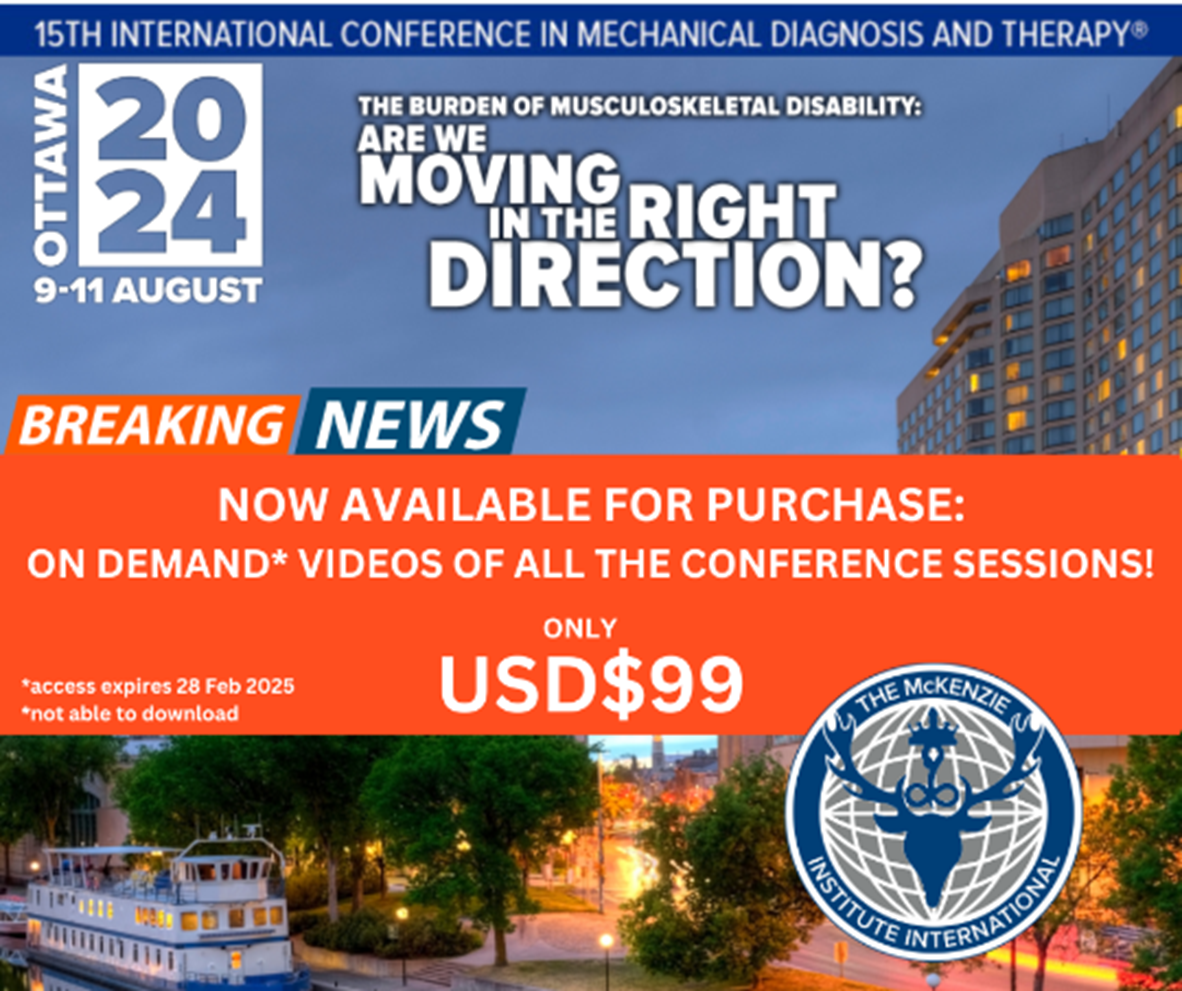
MII have put together a package of recordings of the 2024 MDT Conference in Ottawa. The recordings are available to view on demand, for $99USD, until 28th February 2025.
The package includes:
To see the programme from the conference and what sessions were presented, check the conference program here:
https://mckenzieinstitute.org/ottawa-2024/ottawa-2024-program/
If you would like to purchase the video package, please click here:
https://mckenzieinstitute.org/ottawa-2/conference-registration-on-demand-video-content/
Please email tanya.fulcher@mckenzieinstitute.org if you have any queries about the MII conference package.
Please note: the recorded material is viewable but not downloadable.

The McKenzie Institute Australia (MIA) is establishing a mentoring program for Part A participants to assist them with their McKenzie MDT journey, to encourage them to complete Parts A-E and the Credentialing exam… and maybe even get them consideringr the Diploma Program
Mentoring has many benefits for both the mentor and the mentee. It can challenge your own clinical reasoning, test your existing knowledge, develop or consolidate teaching, coaching & communication skills, and, it can be rewarding to see growth in less experienced clinicians. Mentoring also attracts MDT CPD points, which are essential to maintain your listing on the Clinician Locator. The mentee of course gets the benefit of your knowledge and experience in a supportive environment.
The MIA Board will support members who agree to be mentors by hosting an online information sessions, to outline MIA's expectations and to assist with any questions or concerns. Remember, you can register your interest at any time!
Please contact education@mckenzieinstituteaustralia.org if you would like to assist usus with the program.
Sara Reed
Deputy Chair & Honorary Secretary
Monitor the MIA website's Calendar of Events and follow us on social media for details of further courses, as they are released.
 |
Part B - The Cervical & Thoracic Spine |
 |
Part D - Advanced Cervical and Thoracic Spine & Extremities – Upper Limb |
 |
Part A - The Lumbar Spine When: Friday 21 - Sunday 23 March 2025 Where: Sydney, NSW Click here for further details and to register |
|
2025 Education Update - MDT Management of Chronic Pain |
|
Credentialling Exam |
|
Part B - The Cervical & Thoracic Spine When: Friday 25 - Sunday 27 July 2025 Where: Sydney, NSW Click here for further details and to register |
|
Part A - The Lumbar Spine |
|
Part A - The Lumbar Spine |
|
Case Manager Volumes 1, 2 & 3 |
 |
 |
 |
Do you have something you’d like to share with other MDT trained clinicians? If so, please get in touch! Submissions to the newsletter are always welcome and contributions contribute to MDT CPD points for members. Tell us about an interesting clinical experience you’ve had, an article you’ve read or a case study that challenged you. Submissions can be emailed to: education@mckenzieinstituteaustralia.org