Benefits of MDT
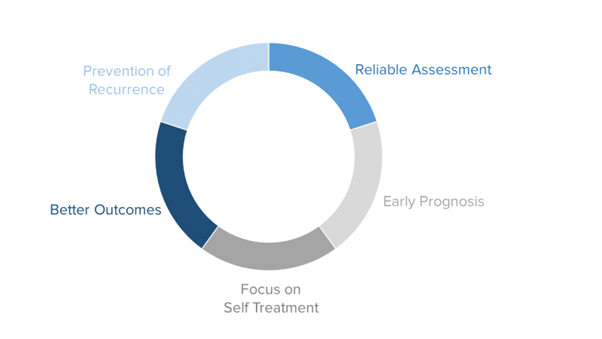
1. Reliable Assessment
To be effective, any treatment system must be based upon a sound assessment and an accurate diagnosis or classification.
Scientific research supports the reliability of the McKenzie system1-4 and a higher level of training can assist to further improve this5.
Numerous studies provide data on the prevalence rates, demonstrate the comprehensiveness of the system6-8 and the validity of the diagnostic process9,10.
2. Early prognosis
Patients commonly want information about their prognosis11-13.
The McKenzie evaluation process makes it possible to predict patient prognosis mostly within 1-2 consultations14-17.
3. Focus on Self Management
The emphasis on self-management empowers the patient and helps foster a strong sense of independence. Research demonstrates that patients who are empowered through participation in their own care acquire the skills, knowledge and confidence that result in beneficial outcomes18.
Further research has shown that management with a patient specific exercise program based on a classification system monitoring symptomatic and mechanical responses achieves better outcomes than non-specific exercise therapy19,20.
4. Better Outcomes
The McKenzie evaluation allows a quick determination of who will benefit from management according to the McKenzie principles21,22.
Using McKenzie Sydstem strategies has been shown to be able to:
- reduce surgery rates23
- avoid surgical interventions24,25
- lead to better outcomes than therapy that is focused on spinal manipulation26 or general exercise27
- be cost effective28,29
5. Prevention of recurrence
Patients who have been educated in self-management are able to initiate treatment at the first sign of recurrence.
Symptoms can usually be relieved before they become severe30-32.
References:
- Heidar Abady, Afshin; Rosedale, Richard; Overend, Tom J.; Chesworth, Bert M.; Rotondi, Michael A. (2014): Inter-examiner reliability of diplomats in the mechanical diagnosis and therapy system in assessing patients with shoulder pain. In: The Journal of manual & manipulative therapy 22 (4), S. 199–205. DOI: 10.1179/2042618614Y.0000000068.
- 2. Kilpikoski, Sinikka; Airaksinen, Olavi; Kankaanpaa, Markku; Leminen, Paivi; Videman, Tapio; Alen, Markku (2002): Interexaminer reliability of low back pain assessment using the McKenzie method. In: Spine 27 (8), S. E207-14.
- May, Stephen; Ross, Jenny (2009): The McKenzie classification system in the extremities: a reliability study using Mckenzie assessment forms and experienced clinicians. In: Journal of manipulative and physiological therapeutics 32 (7), S. 556–563. DOI: 10.1016/j.jmpt.2009.08.007.
- Willis, Sean; Rosedale, Richard; Rastogi, Ravi; Robbins, Shawn M. (2016): Inter-rater reliability of the McKenzie System of Mechanical Diagnosis and Therapy in the examination of the knee. In: Journal of Manual & Manipulative Therapy, S. 1–18. DOI: 10.1080/10669817.2016.1229396.
- Werneke, Mark W.; Deutscher, Daniel; Hart, Dennis L.; Stratford, Paul; Ladin, Joel; Weinberg, Jon et al. (2014): McKenzie lumbar classification: inter-rater agreement by physical therapists with different levels of formal McKenzie postgraduate training. In: Spine 39 (3), S. E182-90. DOI: 10.1097/BRS.0000000000000117.
- May, Stephen; Aina, Alessandro (2012): Centralization and directional preference: a systematic review. In: Manual therapy 17 (6), S. 497–506. DOI: 10.1016/j.math.2012.05.003.
- Hefford, Cheryl (2008): McKenzie classification of mechanical spinal pain: profile of syndromes and directions of preference. In: Manual therapy 13 (1), S. 75–81. DOI: 10.1016/j.math.2006.08.005.
- May, Stephen J.; Rosedale, Richard (2012): A survey of the McKenzie Classification System in the Extremities: prevalence of mechanical syndromes and preferred loading strategies. In: Physical therapy 92 (9), S. 1175–1186. DOI: 10.2522/ptj.20110371.
- Werneke, Mark W.; Hart, Dennis; Oliver, Dave; McGill, Troy; Grigsby, David; Ward, Jason et al. (2010): Prevalence of classification methods for patients with lumbar impairments using the McKenzie syndromes, pain pattern, manipulation, and stabilization clinical prediction rules. In: The Journal of manual & manipulative therapy 18 (4), S. 197–204. DOI: 10.1179/106698110X12804993426965.
- Apeldoorn, Adri T.; van Helvoirt, Hans; Meihuizen, Hanneke; Tempelman, Henk; Vandeput, David; Knol, Dirk L. et al. (2016): The Influence of Centralization and Directional Preference on Spinal Control in Patients With Nonspecific Low Back Pain. In: The Journal of orthopaedic and sports physical therapy 46 (4), S. 258–269. DOI: 10.2519/jospt.2016.6158.
- Hasenbring, Monika I.; Pincus, Tamar (2015): Effective reassurance in primary care of low back pain: what messages from clinicians are most beneficial at early stages? In: The Clinical journal of pain 31 (2), S. 133–136. DOI: 10.1097/AJP.0000000000000097.
- Schmidt, E.; Gramm, L.; Farin, E. (2012): Kommunikationspräferenzen chronischer Rückenschmerzpatienten in der medizinischen Rehabilitation. In: Schmerz (Berlin, Germany) 26 (1), S. 69–76. DOI: 10.1007/s00482-011-1105-5.
- Ali, Nancy; May, Stephen (2015): A Qualitative Study into Egyptian Patients' Satisfaction with Physiotherapy Management of Low Back Pain. In: Physiotherapy research international: the journal for researchers and clinicians in physical therapy. DOI: 10.1002/pri.1647.
- Edmond, Susan L.; Cutrone, Guillermo; Werneke, Mark; Ward, Jason; Grigsby, David; Weinberg, Jon et al. (2014): Association between centralization and directional preference and functional and pain outcomes in patients with neck pain. In: The Journal of orthopaedic and sports physical therapy 44 (2), S. 68–75. DOI: 10.2519/jospt.2014.4632.
- Edmond, Susan L.; Werneke, Mark W.; Hart, Dennis L. (2010): Association between centralization, depression, somatization, and disability among patients with nonspecific low back pain. In: The Journal of orthopaedic and sports physical therapy 40 (12), S. 801–810. DOI: 10.2519/jospt.2010.3334.
- Werneke, Mark W.; Hart, Dennis L.; Resnik, Linda; Stratford, Paul W.; Reyes, Adrian (2008): Centralization: prevalence and effect on treatment outcomes using a standardized operational definition and measurement method. In: The Journal of orthopaedic and sports physical therapy 38 (3), S. 116–125. DOI: 10.2519/jospt.2008.2596.
- Deutscher, Daniel; Werneke, Mark W.; Gottlieb, Ditza; Fritz, Julie M.; Resnik, Linda (2014): Physical therapists' level of McKenzie education, functional outcomes, and utilization in patients with low back pain. In: The Journal of orthopaedic and sports physical therapy 44 (12), S. 925–936. DOI: 10.2519/jospt.2014.5272.
- Vahdat S ; Hamzehgardeshi L; Hessam S; Hamzehgardeshi Z (2014): Patient involvement in health care decision making: A review. In: Iran Red Cross Med J, 16 (1):e12454: DOI: 10.5812/ircmj.12454
- Long, Audrey; Donelson, Ron; Fung, Tak (2004): Does it matter which exercise? A randomized control trial of exercise for low back pain. In: Spine 29 (23), S. 2593–2602.
- Rosedale, Richard; Rastogi, Ravi; May, Stephen; Chesworth, Bert M.; Filice, Frank; Willis, Sean et al. (2014): Efficacy of exercise intervention as determined by the McKenzie System of Mechanical Diagnosis and Therapy for knee osteoarthritis: a randomized controlled trial. In: The Journal of orthopaedic and sports physical therapy 44 (3), S. 173-81, A1-6. DOI: 10.2519/jospt.2014.4791.
- Rasmussen C, Nielsen G, Hansen V, Jensen O, Schioettz-Christensen B. Rates of Lumbar Disc Surgery Before and After Implementation of Multidisciplinary Nonsurgical Spine Clinics. Spine Vol. 30, 21. 2005
- van Helvoirt, Hans; Apeldoorn, Adri T.; Ostelo, Raymond W.; Knol, Dirk L.; Arts, Mark P.; Kamper, Steven J.; van Tulder, Maurits W. (2014): Transforaminal epidural steroid injections followed by mechanical diagnosis and therapy to prevent surgery for lumbar disc herniation. In: Pain medicine (Malden, Mass.) 15 (7), S. 1100– 1108. DOI: 10.1111/pme.12450.
- van Helvoirt, Hans; Apeldoorn, Adri T.; Knol, Dirk L.; Arts, Mark P.; Kamper, Steven J.; van Tulder, Maurits W.; Ostelo, Raymond W. (2016): Transforaminal epidural steroid injections influence Mechanical Diagnosis and Therapy (MDT) pain response classification in candidates for lumbar herniated disc surgery. In: Journal of back and musculoskeletal rehabilitation. DOI: 10.3233/BMR-160662.
- Petersen, Tom; Larsen, Kristian; Nordsteen, Jan; Olsen, Steen; Fournier, Gilles; Jacobsen, Soren (2011): The McKenzie method compared with manipulation when used adjunctive to information and advice in low back pain patients presenting with centralization or peripheralization: a randomized controlled trial. In: Spine 36 (24), S. 1999–2010. DOI: 10.1097/BRS.0b013e318201ee8e.
- Albert H, Manniche C. (2012): The Efficacy of Systematic Active Conservative Treatment for Patients with Severe Sciatica. A Single-Blind, Randomized, Clinical, Controlled Trial. Spine Vol 37, 7.
- Manca A, Dumville J, Torgerson D, Klaber Moffett J, Mooney M, Jackson D, Eaton S (2007) Randomized trial of two physiotherapy interventions for primary care back and neck pain patients: cost-effectiveness analysis. Rheumatology 46: 1495-1501
- Larsen, Kristian; Weidick, Flemming; Leboeuf-Yde, Charlotte (2002): Can passive prone extensions of the back prevent back problems? A randomized, controlled intervention trial of 314 military conscripts. In: Spine 27 (24), S. 2747–2752. DOI: 10.1097/01.BRS.0000035677.18307.FC.
- Matsudaira, Ko; Hiroe, Miho; Kikkawa, Masatomo; Sawada, Takayuki; Suzuki, Mari; Isomura, Tatsuya et al. (2015): Can standing back extension exercise improve or prevent low back pain in Japanese care workers? In: The Journal of manual & manipulative therapy 23 (4), S. 205–209. DOI: 10.1179/2042618614Y.0000000100.
- Udermann, Brian E.; Spratt, Kevin F.; Donelson, Ronald G.; Mayer, John; Graves, James E.; Tillotson, John (2004): Can a patient educational book change behavior and reduce pain in chronic low back pain patients? In: The spine journal: official journal of the North American Spine Society 4 (4), S. 425–435. DOI: 10.1016/j.spinee.2004.01.016.

2.jpg)